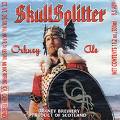
| Skull Splitter Faces Ban The popular Skull Splitter Ale, could be soon withdrawn from sale in the UK . A report from an industry watchdog group claims that Skull Splitter is in breach of the industry code and recommends action be taken against the Orkney Brewery, the makers of Skull Splitter. Skull Splitter, an 8.5% ale created over 20 years ago and sold internationally, was singled out in the report because "it's name implies violence and also the impact the strength may have on the drinker". Orkney Brewery has now launched a campaign to save Skull Splitter, a former Champion Winter Ale of Britain. They say that the ale is in fact named after Thorfinn Hausakluif, the Seventh Viking Earl of Orkney - nicknamed "Skull Splitter" and that the name has no other meaning. Brand manager, Norman Sinclair, added that "Skull Splitter, like all our beers, is a high quality, hand crafted product designed to be savoured by adults who enjoy the real ale experience. We never target any of our beers at a young market, nor do we allow them to be sold cut price. In addition, Skull Splitter is not sold in supermarkets." |
| Wet Hops Typically hops are dried before they are packed, shipped and stored to await the brewing process. Now, some brewers are now using wet hopping. The theory behind wet hops is that as soon as the flowers are picked oils, resins and flavors begin to dry up, so by going direct from the bine to the brew kettle, your hops will pack more punch. The trick works -- beers brewed with wet hops hold more of their distinct flavors. If wet hopping, you might ask, why doesn't everyone do it? Price is a factor plus the fact that a lot of that subtlety of the wet hop is going to be drowned in malts. Hop varietals can be pretty picky in where they will grow and every hour from picking, dryness sets in- getting the hops to the brewery in a hurry is key. So, brewers looking to use wet hops need a field nearby and the dedicated manpower to make it happen. If you're looking to try a wet-hopped selection, Sierra Nevada Harvest Ale is not only good it's available in most parts of the USA. The beer opens with a super shot of Cascade and Centennial hops but is quickly balanced with a steady stream of malt flavor. To learn more about wet hopping check out the video at the Sierra Nevada website: http://www.sierranevada.com/beers/harvest.html |

Feature News from beernexus.com
| Oktoberfest Lingo A Breze is a yeast bread pretzel, small hand sized variety. In the Munich beer gardens and at the Oktoberfest tents you can buy a huge Riesenbreze (giant pretzel) to go with your beer. As for the festival beer, it is only available in a one-litre glass, called a Maß. You drink directly from the big glass. No smaller glasses will be provided. When you want to order a beer, you simply say to the waitress “A Maß, bittschön”. Local Munich breweries create a special beer which has a higher percentage of alcohol than what is served at the fest for their thousands of visitors. You drink that beer out of a one liter Maßkrug. Bud Ale? Budweiser American Ale makes its nationwide debut on draught, 12-ounce six-packs and 22-ounce singles in October. Budweiser American Ale has been in development since early 2007. "We're very pleased with this brew. In competitive blind taste tests of craft beer drinkers, Budweiser American Ale significantly outperformed other craft brands in terms of consumer preference," said Tom Shipley, Budweiser brand director, Anheuser-Busch, Inc. Budweiser American Ale is an all-malt, top-fermented ale that is dry hopped with Cascade hops from the Pacific Northwest and finishes with an ABV of 5.3 percent. Early independent tasters say the beer is fairly nondescript for a 'craft' beer but will have too much flavor for most Bud fasn. |
 |
| |
 |