
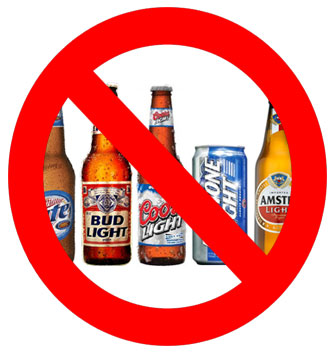
Hoponomics 101: Debunking Light Beer by Clay Moore Too many people drink mass-produced light beers, and these low calorie alternatives to beer flood all known media outlets. Not a day goes by that I don’t see or hear about something that’s “triple hopped,” “coldest tasting,” “most refreshing” or has “drinkability.” As you read this, the following is being Tweeted somewhere: “Drink Kiwi Light…Because the night belongs to Kiwi.” I wish I majored in marketing. When I ask a friend why they drink light beer, they usually respond with: (1) I don’t like the taste of that “dark stuff”; (2) I’m watching my calories; (3) I get too bloated from that “dark stuff”; and (4) light beer is cheaper. I have a pretty good idea what “dark stuff” is, and it includes hoppier, more complex beers, regardless of their style or color. I can’t force someone to drink what I like, but if I can convince a few people that similar calories, less bloating and lower cost is reason enough to give “dark stuff” a second chance (the markedly better taste is obvious), maybe we can convert a few folks. We beer enthusiasts will always choose a full bodied craft brew over a mass produced beer any day of the week. But just in case you needed further justification why light beer isn’t all it’s hyped up to be, read on and forward this to a few of your light-headed friends. Perhaps light beer is the Jamarcus Russell of the beverage industry. To further illustrate why the “dark stuff” is better, I’ve compared five mass produced light beers to “dark stuff” which are readily available in the northeast and other markets. Other than Stone IPA, I recognize that the remaining beers in the “dark stuff” category are not the cream of the hop crop, but we must ease our light beer friends into the pool slowly with choices they can find at most bars, before we push them head first into the Imperial Russian Stout hot tub. So please, don’t get all fantasy beerball on me. I’ve made some additional assumptions: (1) People drink light beer because “Big Beer’s” marketing works; (2) An average light beer drinker will drink anywhere from 5-8 beers in a night; and (3) Light beer is downright tasteless. With assistance from internet websites and labels, and by pricing out beers at the same central Jersey liquor store, I noticed a few things. For those beers I couldn’t find exact calorie contents for, I used an ABV to calorie conversion chart, using the average of a high and low calorie count for consistency (so eat your hearts out light beer fact checkers). I recognize that purchases in bulk may yield differing results price-wise, and that the prices do not reflect actual bar prices. But we need to start somewhere on this journey, and I’m sure that better beers are comparably priced at certain places and not others, especially with numerous happy hour light beer specials like “Fist Pumping Fridays.” So let’s look at some numbers: LIGHT BEERS ABV Cal. $/6 $/Bottle Bud Light 4.2% 110 5.00 .83 Coors Light 4.15% 104 5.18 .86 Miller Lite 4.2% 96 5.15 .86 Heineken Light 3.5% 95 7.75 1.29 Amstel Light 3.5% 99 7.75 1.29 THE “DARK STUFF” Stone IPA 6.9% 220 10.49 1.75 Brooklyn Lager 5.2% 185 8.49 1.42 Guinness Draught 4.27% 144 7.55 1.26 Sam Golden Pilsner 4.6% 145 8.25 1.37 Yuengling Lager 4.4% 135 5.47 91 Yuengling is on par with cost and calories to all light beers, with a slightly higher alcohol content and in my opinion, a far better taste than its light beer counterparts. Guinness is not the muddy, bloaty beer everyone thinks it is. When compared to a light beer, you could burn those extra 34 calories updating your facebook profile. One Stone IPA is just about double the calorie content of all the above light beers. So what? If you consume 2 Amstel Lights or Heineken Lights as compared to one Stone, you’ll end up spending $.85 more on the light beers, and only then will you match its punch. With taste being such an important factor (for me at least), the comparison is about as night and day as you could get. In addition, you’ll consume an extra 12 oz. of beer with those 2 light beers, which will send you to the bathroom sooner rather than later. The difference is Peeability. Had I the time and patience, I could have provided a more in-depth statistical analysis that factored in cost v. ABV v. amount consumed over an average night, and come up with cool terms like “Bloating Factor” and “VPB” (Value Per Beer). I didn’t, but you get the point. The possibilities are endless in support of the “dark stuff.” I wish more people would give better beer a chance. One aspect of better beer is that it is so common to sit down at a bar and end up talking to someone you don’t know about the ins and outs of beer – different styles, flavors, brands and where you’ve tasted it. It doesn’t matter who you are or where you’re from, but it always seems to happen. When was the last time you sat around and discussed the finer points of light beer -- other than “Did you see the commercial where the guy trades his wife for a six pack of [fill in the blank]?” For all you light beer drinkers out there, don’t drink the Kool Aid, because there’s plenty of good beer to go around for all of us. Come on in, the water’s just fine. (send any cheers or jeers about beers to metfanz@yahoo.com) |
 |
| |
 |
More From Moore- nothing but beer here.....
| Clayton Moore Is the nationally noted beer aficionado and the creative force behind the best selling band Lunch Hour- Six Pack "beer for the ear" |

PEE


It's time for more ......TALES OF ALES