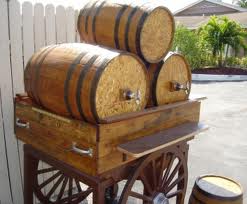
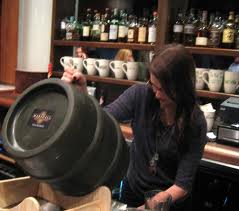
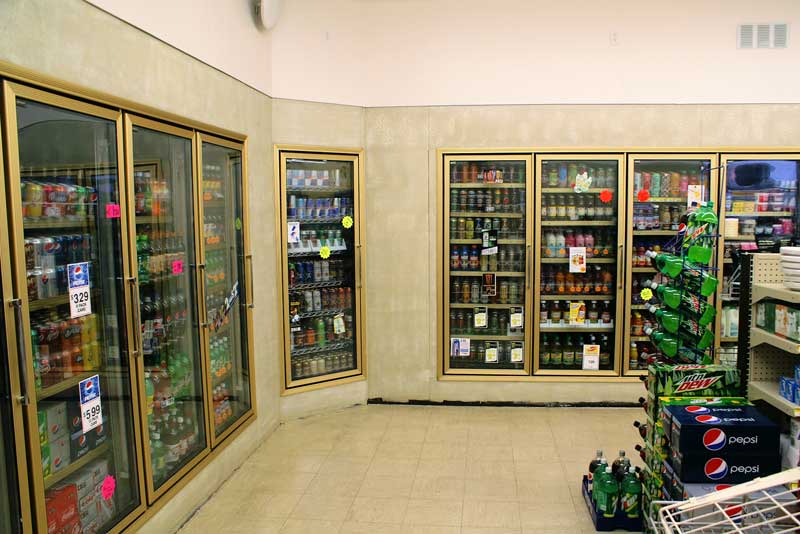
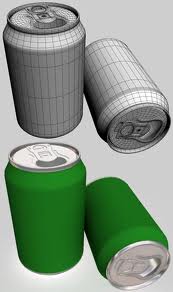
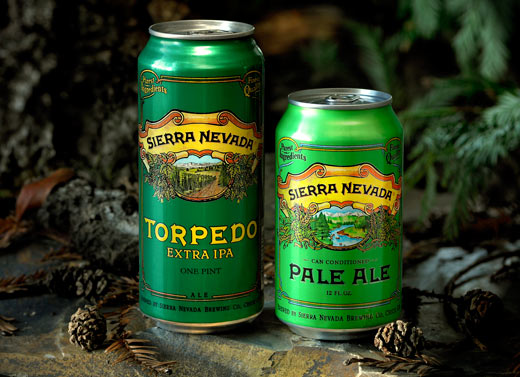
| From Kegs to Cans Michelle Zacherly The way that beer makes it from the fermenter tank to your mouth has technological and industrial history that extends back to the roots of the art of brewing. For most of beers history, draught was the only option and beer was generally never sold or consumed outside a saloon or similar public house. The brewer would transport wagons of wooden casks or kegs (unrefrigerated) on a daily basis and generally only to establishments within a short driving distance. Improvements in refrigeration technology allowed beer to be shipped further away from the brewing site and eventually into domestic spaces. Before the introduction of stainless steel or aluminum kegs, the experience of draft beer was far different. Beer was kept in wooden kegs that offered good but not great protection, and without pressurized or nitrogen tap lines it was generally much less carbonated than modern versions. Pouring a pint had to be accomplished through gravity and physics and a simple hand pump. In recent years, serving practices have become politicized and many beer enthusiasts in Great Britain in response to what they see as an erosion of British culture have lobbied and campaigned to protect these historical techniques through organizations like CAMRA. Most bars and pubs (and more than a few parties) still serve beer in draught form from kegs. Modern kegs are outstanding devices; they keep beer perfectly protected from light, cool quickly and allow for the beautiful experience of drinking beer straight from a tap line. However, statistically, beer today is most often consumed, at home, as the majority of people will use their valuable drinking time with a hand wrapped around a bottle and not a pint glass. Doing that however requires some compromises. Light-striking is an oft-discussed negative quality of forgoing the welcoming of your local watering hole. I've had many a bottle of beer that suffered from a terrible smell and taste caused by the oh so delicate alpha and beta hop acids in the brew being damaged by light. Stop for a second and imagine any given beer store: large fluorescent overhead lights, walls of refrigerated, well-lit cases with glass fronts inviting you to browse its icy-cold contents. However, any beer exposed to a source of ultraviolet light for too long can experience negative changes, as the beer takes on characteristics similar in taste and smell to that of a skunk. Open cases expose the beers inside to both the light of the store and of the sun, so even though they are kept cold their flavors can be damaged. In a perfect world, everyone would be able to get their beer fresh from the brewhouse and drink it straight from the perfect glass. Obviously that isn't the case, so technology has stepped in the service of civilization. Most craft beer is wisely packed in l brown glass bottles, which in addition to being cheaper to produce than other types of glass somewhat adequately protect the glorious contents within from harmful light. Note please that I said "somewhat adequately protect". For the ultimate protection the answer is canning. Yes, glass bottles, have become a marker of quality but simply put, cans are better. Like miniature kegs, cans provide complete protection from UV light as well as act as excellent insulators, meaning your beer gets colder quicker and stays that way longer. Moreover, cans are more durable and therefore more transportable, which benefits brewers by increasing space on distribution trucks and reducing fuel costs. Consumers are able to bring their favorite malt beverages into locations where glass is normally not allowed, such as pools, parks or ballgames. Cans reduce the sticky and dangerous risk of bottles breaking during transportation and are recycled at a much higher rate than glass. In terms of taste, despite extremely persistent beliefs to the contrary, cans DO NOT leave any residual taste in beer. Modern cans come with an internal liner that insulates the beer from ever making contact with metal. Even if you are concerned about metal interfering through the pop-top opening, well you shouldn't be having your beer out of anything except a drinking glass anyway. Any metallic taste is entirely imaginary and a psychosomatic result of years of advertising and cultural condition or from oxidation, which occurs when hops begin to age. And now some craft brewers have invested heavily in cans. Three years ago about 50 small brewers were selling beer in cans. Now, in 2012 the number has grown to nearly 200 breweries in 43 states. Sierra Nevada recently released its Pale Ale and Torpedo India pale ales in cans. Boston beer maker Samuel Adams, long an ardent opponent of selling beers in cans has announced plans to do just that as have Lancaster, Troegs, and many other breweries. They are all following in the footsteps of the pioneer of canning craft beer, Oskar Blues, a brewery that singlehandedly fought the notion that only bad, cheap beer comes in a can. It was, and still is, a difficult fight but the tide has turned, and I for one am glad it did! -------------------------------------- -------------------------------------------------------------------------------- |
beernexus.com - SPECIAL REPORT


Tasting The Right Way
 |
| |
 |
 | |  |