|
| |
 |

| Beer Around the World |
| Dinosaur Beer |
| A decade ago Raul Cano, a scientist at California University, drilled a hole into a piece of ancient Burmese amber to extract yeast that has lain dormant there for up to 45 million years, Now he's using that yeast to commercially brew barrels of pale ale and German wheat beer through the Fossil Fuels Brewing Company. "You can always buy brewing yeast, but our yeast has a double angle: we have yeast no one else has and our own beer recipes." Part of our beer's taste comes from the yeast's unique metabolism. "The ancient yeast is restricted to a narrow band of carbohydrates which can consume just about any kind of sugar," said Cano. If any of this has a ring of deju-vu, it could be because Cano's amber-drilling technique is the same one popularized in the movie Jurassic Park. |
| The contribution of Asia to the progress of the beer market cannot be understated and the region now accounts for around a third of all beer sales. In 2009, the region managed to record a 5% increase in volume. China, which accounts for 7 in every 10 litres of beer sold in Asia is the key driver and is helping to sustain the overall worldwide beer market. Latin America can also take some of the credit for facilitating the progress of the world wide beer market with 2009 sales that have increased a healthy 3%. As with Asia, there is one market that is acting as a major stimulant- it is Brazil. The fourth biggest producer of beer in the world, Brazil enjoyed a 4% volume growth last year helped by competitive pricing and a vibrant off-premise market. The Middle East & North Africa that are the fastest growing regions in the world, registering double digit growth last year. However, due to religious and cultural reasons, total sales are insignificant and account for less than 1% of world beer sales. Consumers in that region drink just 2 litres each, far under the world wide average. North America and Europe make up 45% of global beer volumes and with sales flattening in North America and European volumes falling |

Big Beer, Big Price- Utopias by The Boston Beer Co. claims to be "The
World's Strongest Beer." The beer, which is fermented in old wooden bourbon casks,
weighs in at a hefty 27 percent (54 proof) alcohol by volume. Utopias has a warm,
sweet flavor is richly highlighted with hints of vanilla, oak and caramel. While the
alcohol content may be strong, the price tag alone might be enough to sober you up.
Utopias runs $150 per bottle.
Cocktails, Anyone?- The most common beer "cocktails" simply are equal parts
of two types of beer or cider layered on top of each other in a pint glass. This includes a
dark stout with a light-colored ale in the Black and Tan, and lager beer and hard apple
cider in the Snakebite. The Black Velvet is a mix of stout and Champagne best poured as
follows: Fill glass halfway with bubbly, then pour stout over a spoon, slowly, to create a
layered effect. The Michelada is a refreshing cocktail made with beer, lime juice, and hot
sauce, served in a salt-rimmed glass over ice. Popular in the U.K., Shandy which mixes
equal parts beer with either ginger ale or carbonated lemonade.
Too Light?- Light beers account for about half of the $99 billion-a-year beer
market in the USA. But experts believe the overall market for super-low-calorie is
probably small. MillerCoors says MGD 64 (slogan: "As light as it gets") has sold twice as
much in its first year as Miller Genuine Draft Light, which it replaced a year ago. After a
few weeks of testing Select 55 in 15 markets, Anheuser-Busch decided to expand into a
dozen more starting last month and will soon go national.
World's Strongest Beer." The beer, which is fermented in old wooden bourbon casks,
weighs in at a hefty 27 percent (54 proof) alcohol by volume. Utopias has a warm,
sweet flavor is richly highlighted with hints of vanilla, oak and caramel. While the
alcohol content may be strong, the price tag alone might be enough to sober you up.
Utopias runs $150 per bottle.
Cocktails, Anyone?- The most common beer "cocktails" simply are equal parts
of two types of beer or cider layered on top of each other in a pint glass. This includes a
dark stout with a light-colored ale in the Black and Tan, and lager beer and hard apple
cider in the Snakebite. The Black Velvet is a mix of stout and Champagne best poured as
follows: Fill glass halfway with bubbly, then pour stout over a spoon, slowly, to create a
layered effect. The Michelada is a refreshing cocktail made with beer, lime juice, and hot
sauce, served in a salt-rimmed glass over ice. Popular in the U.K., Shandy which mixes
equal parts beer with either ginger ale or carbonated lemonade.
Too Light?- Light beers account for about half of the $99 billion-a-year beer
market in the USA. But experts believe the overall market for super-low-calorie is
probably small. MillerCoors says MGD 64 (slogan: "As light as it gets") has sold twice as
much in its first year as Miller Genuine Draft Light, which it replaced a year ago. After a
few weeks of testing Select 55 in 15 markets, Anheuser-Busch decided to expand into a
dozen more starting last month and will soon go national.


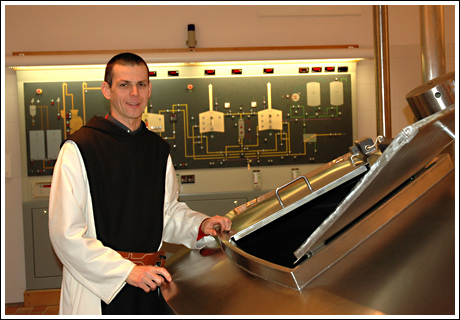
| Only Seven in the World Achel, Chimay, Orval, Rochefort, Westmalle and Westvleteren from Belgium and La Trappe from the Netherlands are the world's only Trappist brews. Trappist beers are distinct from Abbey beers which are commercially produced with links to a monastery or just given monastic branding. Monks do not actually produce Abbey beers. For example, Anheuser-Busch InBev's Leffe is named after a real abbey, but brewed in a huge 6 million hectolitre capacity plant. The large majority of brewing monks are in their late 60s or 70s which leads to questions about the future. Some of these religious communities could disappear, acknowledges the abbot of Koningshoeven Abbey in the Netherlands, where monks still prepare gift packages of its La Trappe beer. Monks ensure the marketing of Westmalle beer is earnest and have capped production at 120,000 hectolitres (12 million litres), making it the second largest Trappist brewer, after Chimay. "There's more demand than we can supply. We've not seen any tail-off," said Brother Assche, adding the monks on the brewery's board had decided to limit volumes. "We're here to serve the abbey and we make enough." Chimay, the most internationally recognised Trappist beer, has pushed the hardest commercially, exporting around 45 percent of its 160,000 hectolitres output. Westvleteren has gone to the opposite extreme, with a limited 4,500 hectolitres still brewed by monks. Its beer is only sold in crates to individuals at the gates on the understanding that they do not resell it commercially. send contributions for On Tap to webmaster@beernexus.com |

| QUICK HITS |
Beernexus.com
FLASH NEWS - FLASH NEWS - FLASH NEWS - FLASH NEWS - FLASH NEWS - FLASH NEWS
Edited by Jim Attacap